An Armful of Kusa Grass

An Armful of Kusa Grass (OPWC Ch. 3)
– December 16, 2025, 11:04 am to 11:48 am
Another mode of temporal organization gets unlocked at the outset: as young Svasti meditates while seated by a tree, a new initiate at the Buddha’s training center, his mind returns to the moment nine years earlier when he first met the Buddha. While in Chapter 1, the narrative’s first propulsion comes as a result of Svasti’s decision to walk the path of the Buddha and study with
him, in Chapter 3, another temporal portal opens around an earlier fated encounter with the Buddha. As Svasti closes his eyes and drifts back in time, we follow him to a small village on the outskirts of a forest, where he is an eleven-year-old boy carrying responsibility beyond his years, tending water buffaloes to support his three younger siblings—all of whom seem insanely mature and gifted (the six-year-old girl, Bala, prepares complex meals for the other children). One evening, just after cutting “an armful of kusa grass” for the water buffaloes, Svasti decides to take a short break to stand peacefully in the forest. There he encounters, with wonder, a man sitting beautifully “beneath a pippala tree… [holding] himself with the utmost stability and inner purpose… body radiated peace, serenity, and majesty” (21). Nearing Enlightenment, I would say? This, of course, is Prince Siddhartha, on the cusp of becoming the Buddha, meditating and hyper-worlding.
During their initial encounter, Hanh takes some time to explain the caste system, which contextualizes why Siddhartha’s warm and loving treatment of Svasti position him on an entirely different ethical register from the general public. We learn that, “as an Untouchable, [Svasti] did not belong to any of the four social castes” (22). These are:
Brahmana
Khastriya
Vaishya
Shudra
Notably, Hanh reminds us that “sacred scriptures taught that happiness was the ability to accept one’s position” (22)-- and that this toxic positivity was used to justify and naturalize the caste system. We’ll come back to that. But this flattening and cynical harnessing of affect as a regulator for social inequality and stigma is very quickly set at a distance from the teachings of the Buddha/Siddhartha. The next sentence confirms the violence of the configuration: “If an untouchable like Svasti touched a person of a higher caste, he would be beaten.” Of course. The ideological apparatus comes in first, and when that doesn’t work, the repressive apparatus reasserts control. Siddhartha seems to be offering another frame altogether. I’m listening.
“... Svasti did not want to be the cause of pollution of someone so special, and that was why he froze when he and the man were a few steps apart” (23)
I think that this, in a certain sense, helps me understand how my communication with Drew changed beginning in the fall, after I learned that his Star 0262 TIL infusions had failed and was causing him a great deal of physical suffering. I’m not sure that I necessarily imagined myself as “pollution,” but I certainly began to think differently about the kind of presence I was showing up with. I also tried to do a better job of anticipating any unintended pressures or burdens that various utterances, affects, postures, or gestures from me might place on Drew as he prepared to die; meaning, I started to organize my symbolic offerings and communications primarily around whether or not they would “contaminate” his work of transitioning from this life into the next. What needs to be said? What wants to be said? In other words, what helps him as the listener, as the receiver; and what might I be tempted to say that just helps me, or makes me feel better? I tried to avoid that where possible. But I also think it’s part of why I froze in relation to OPWC and wasn’t able to deliver a coherent engagement with the text in those last few weeks: reading in paralysis, in crisis mode, is not the kind of reading that invites, enables, facilitates deep connection. Reading in meditative mode, in daily mode, in practice mode, in contemplation and reflection, with rigor and discipline and a sense of being in time rather than out of time, creates connection with the dead, with ghosts, I think Avital Ronell has an entire book about that. Dictations. Taking dictations, liminal states, haunted writing, something like that.
Siddhartha and Svasti have a short conversation, where Siddhartha confirms that he rejects the logic of social stratification (“You are a human being and I am a human being. You can’t pollute me. Don’t listen to what people tell you”), previewing one of his key teachings about suffering as the portal for connection and becoming awake, which deepens in Chapters 4 and 5. Feeling a warm bond with Siddharta already, Svasti expresses his joy and his desire to give a gift, which coexists with his perceived incapacity (he believes he has nothing to give). Siddhartha asks for the kusa grass, which he wants to use as a meditation cushion—in other words, he asks for material support, for something soft to sit on that is “slightly fragrant.” Importantly, Siddhartha doesn’t ask Svasti for the entire pile of grass, he asks only for “a few handfuls” from it, and he receives a “large bundle”-- though, again, not the entire pile. This strikes me as another example of humility in motion, a lessening of greed (gremlin within: listen up!): just as there is asking for too much, there is giving too much. Better to ask for just what you need and what the other can (here, visibly, as the grass is right behind him) give, because that invites the other into generosity. Some kind of subtle choreography of loving exchange there that’s reassuring.
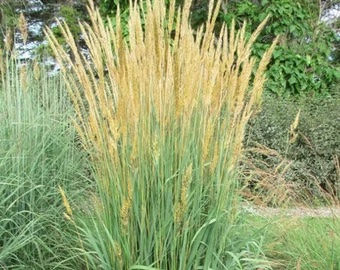

Svasti runs off to cut more kusa grass for the buffaloes, promising to return to the forest to visit Siddhartha again the next afternoon. I, in turn, promise to return in a few hours to the next chapter of this text, where the walk with Drew takes another step.
– Dianna
Comments