The Sutras, According to Effie White (Part One)

Updated: Dec 22, 2025
What traces of presence vibrate, even through absence? What does devotion look like, and feel like, in the wake of disappearance? Can love continue without any promise or possibility of return, let alone recognition? How do you turn mirrors from reflective panels into portals? How does a scream become sublime?
Enter Effie White, here played by Jennifer Hudson in the film adaptation of Dreamgirls. After spending years singing lead for the Dreamettes and dating Curtis, the manager, Effie learns that she’s been replaced by Deena/Beyonce as the lead singer. Then, another blow: she’s being kicked out of the group, can’t even sing backup. And then, another: Deena/Beyonce is now dating Curtis. Finally, to add insult to injury, Curtis helpfully points out to Effie that she’s also being fired because she’s “getting fatter all the time.” (He hasn’t heard the news yet: she’s pregnant with his child, which is why she’s gained weight. Ever the gentleman!). Fittingly, this all goes down in a song called, “It’s All Over.” Everyone except Curtis exits the stage—no audience, it’s a rehearsal from hell—and Effie begins to sing, “(And I Am Telling You) I’m Not Going” in response to structural betrayal: the sudden, unexpected collapse of her world.

(And I am telling you), I’m not going
You’re the best man I’ve ever known
There’s no way I could ever go
Medium shot: mirrors arranged behind her, reflecting herself at a canted angle, half a blue lighting gel. Body upright, stalwart, determined. Faced with Curtis’s imminent departure, she does not beg him to stay. Instead, she tells him that she’s not going (to leave, not going anywhere). In other words, she immediately accepts the central reality premise, contrary to what the overwhelming affect might suggest: she knows that she has no control over whether or where he goes. So she makes a vow contingent only to do what is within her capacities and within the boundaries of the possible. She doesn’t follow him. She doesn’t chase. She declares her own intentions, clearly on the humbler side (so far, just: I’m telling you, I’m not going). Anticipating his absence, she affirms the continuity of her presence via negation:
No, no, there’s no way, no, no, no, no way I’m living without you
I’m not living without you
I don’t want to be free
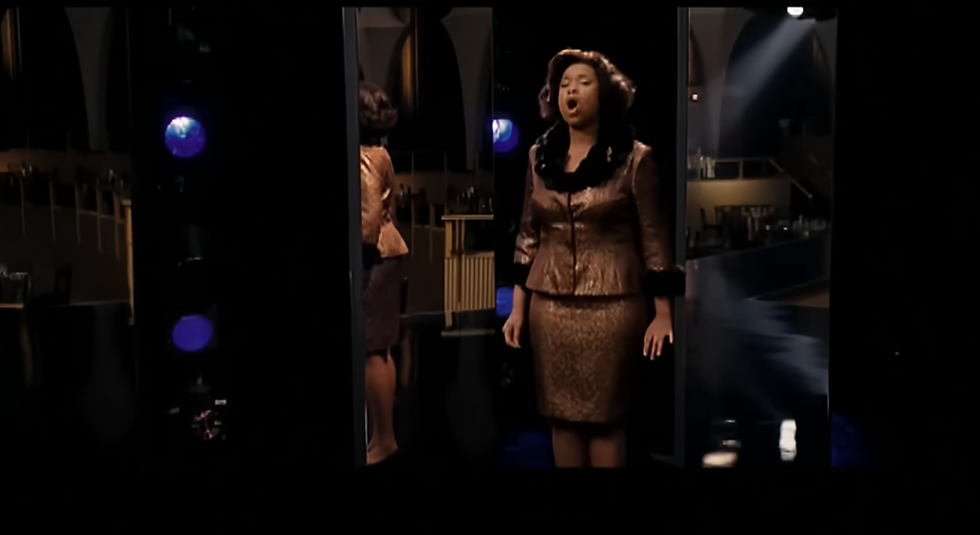
So many “no’s.” Are they simply denial, or do they have a more liturgical valence, both in their rhythm and their repetition? Not going/no no no no way/ not living without/ don’t want… What, exactly, is being negated here? Is it Effie’s fantasy? (Yes, obviously, but let’s go deeper). Zoom out, with the camera, and what do we see? More exposure of the frames and the scaffolding, not to mention the flattening reflective tripod behind Effie. Negation exposes the structure of her romantic recognition fantasy and its contingency, its fragility. Then we get: I’m not living without you/ I don’t want to be free. What does she not want to be free from, at this point in the song? Her illusions. Her attachments. Her love object. And the frames, the scaffolding, the illuminations that let her cling to her illusions and reflect them back to her: nothing there but an empty room.
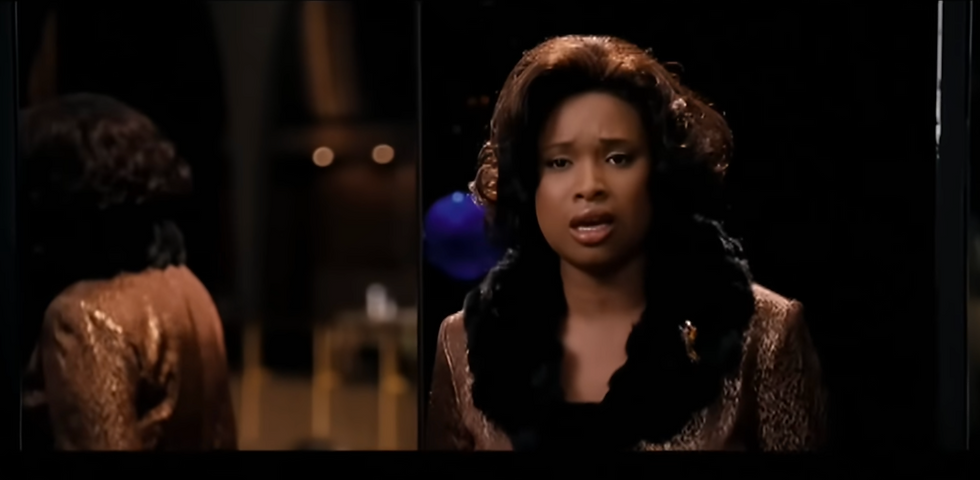
I’m staying
And you, and you—you’re gonna love me.
Like the dash in the above line, we get a few quick and jarring cuts to Curtis, in medium-close-up. These shots don’t necessarily bring the viewer into a shot-reverse-shot formation that confirms a conversation and connection between Effie and Curtis; rather, they are intermittently placed between multiple, shifting shots of Effie, alternating between medium and close-up angles, and so their main function seems to be a reminder that he’s still in the room. While initially emerging from the anticipatory grief about his imminent exit, the indelible affect in this song quickly exceeds any singular object. Indeed, as the camera gets closer and closer to Effie, the visual effect comes closer to suggesting that she is singing to her own reflected image in the mirror at least as much as she is to him. This isn’t about her (or anyone’s) “narcissism” — mirrors are way more interesting than that would allow – it’s about asymmetrical recognition that impedes, but doesn’t foreclose, the possibility of relating.


Comments